


Local Politics and Real Estate
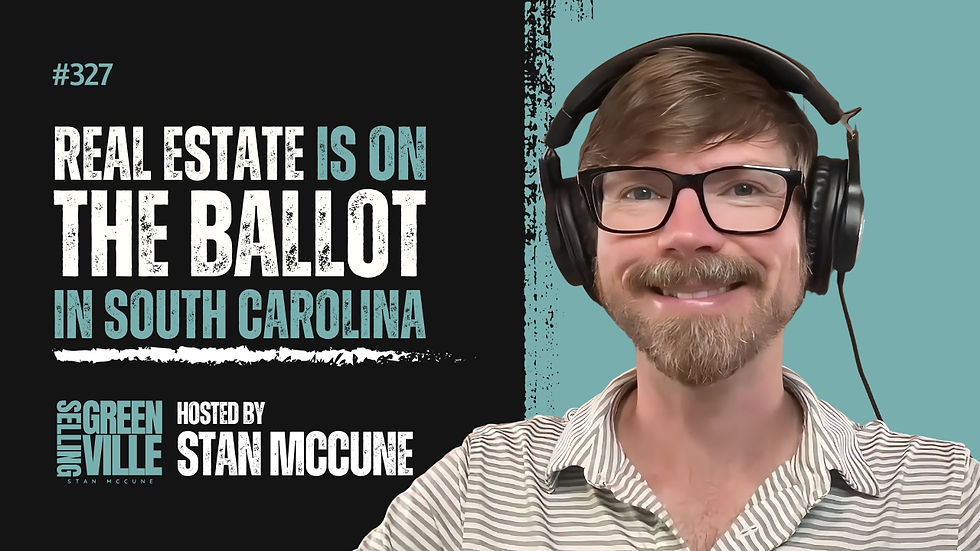
Election years always bring noise. In Greenville, they also bring real consequences for how—and where—people live. On a recent episode of Selling Greenville, the conversation zoomed in on local and state decisions that shape housing more directly than anything happening in Washington. From impact fees to tax policy, from growth fights to gentrification, the candidates running this cycle are debating issues that hit every street, driveway, and closing table in the Upstate.
A few framing notes from the episode: there’s no candidate endorsement here. Instead, the lens is practical and nonpartisan—rooted in conversations with contenders for Greenville County Council and the South Carolina House. Those interviews happened under the umbrella of the REALTOR® Political Action Committee (RPAC), which represents roughly 4,000 Upstate REALTORS®. The local committee members aren’t lobbyists; they interview, listen, and highlight the housing implications of each platform.
Oh—and if you think your vote won’t matter locally, remember this: a recent County Council race was decided by four votes. Four.

Greenville Local Politics and Real Estate
Greenville local politics: The thread connecting nearly every candidate interviewed? Housing—directly or indirectly. Here’s what keeps coming up, and how each topic ties back to your front door.

1) Infrastructure—and who pays for it
Everyone wants smoother commutes, safer intersections, and utility capacity that actually matches growth. The sticking point is who foots the bill.
Developers vs. broader funding: One path is to make builders pay more via impact fees for things like road widening and utility expansion. Another path is state-level funding (past cycles considered gas tax increases when prices were low). Both routes are thorny. If you load too much onto new communities, you raise costs and risk choking off projects the region says it needs. If you spread it too broadly, you’ll hear pushback from taxpayers who aren’t moving into those new homes.
Urban vs. rural: Densely traveled corridors naturally get attention, but rural districts are growing, too—and some are watching roads crumble while dollars flow elsewhere. Expect candidates to argue hard for “their” share.
The upshot: infrastructure isn’t an abstract line item. It determines where new homes can actually be built—and how expensive those homes become once the cost of roads and pipes gets priced in.
2) Housing affordability (and the supply equation)
“Affordability” means different things to different candidates:
Set-asides & incentives: Many non-incumbents talk about requiring or incentivizing developers to include affordable apartments or lower-cost for-sale units in new projects—often through public-private collaboration.
Build more—period: Incumbents tend to emphasize that affordability also improves when overall supply rises. More homes across the board relieve pressure, even if a given project isn’t labeled “affordable.”
A recurring tension emerged in the interviews: if policymakers demand more affordable units and shift infrastructure costs onto builders, projects can get squeezed from both sides—sometimes to the point of not happening at all. Voters should look for candidates who can balance the moral urgency of affordability with the practical math of getting homes built.
3) Growth: everyone wants it—somewhere else
Greenville County’s population is expected to increase dramatically over the next decade, on the order of two hundred thousand-plus new residents. That growth needs roofs.
Yet multiple candidates admitted they’d prefer other districts carry the housing load. That’s a recipe for stalemate: communities want new grocery stores, parks, and employers, but resist the neighborhoods that make those amenities viable.
One example from the episode drove this home. In the Donaldson Center area, residents have long wanted a grocery store. Retailers use strict metrics—household count, income levels, and more—before greenlighting a site. One candidate in that district grasped the obvious but often-overlooked solution: add more housing nearby to tip the numbers in favor of everyday essentials. Without people, nothing pencils.
4) Gentrification: value up, neighbors out
As values rise, reassessments push property taxes higher. For longtime owners on fixed incomes, that can strain budgets to the breaking point. Several candidates want pathways that help people stay in or return to their communities when change accelerates—possibly by increasing access to affordable rentals (think apartments or condos) within the same area.
The episode doesn’t pretend this is simple. Gentrification “cuts both ways”: it boosts equity for some while displacing others. The next wave of local policy conversations will have to address both truths at once.
5) Property taxes: who pays—and how much
Talk taxes, and you’ll quickly end up at the state level. A few realities from the candidate interviews:
Owner-occupied vs. non-owner-occupied: South Carolina has one of the lowest owner-occupied property tax rates in the country and one of the highest rates on non-owner-occupied property. That helps explain why rents have ballooned—landlords are carrying a heavy tax load and passing costs along.
Services vs. contribution: One candidate cited a striking ratio: for every $1 an owner-occupant pays, they receive more than that back in public services (the figure mentioned was roughly $1.14 in services per dollar paid). That gap gets filled by businesses and rental property owners.
Changing it is hard: making taxes more equitable across use types would mean reworking the entire tax code. Politically, that’s tough—especially when “landlord” is a loaded word despite the fact that most rental owners are small, mom-and-pop operators, not national corporations.
For voters, the key is understanding how these tax structures ripple through housing: penalize rentals too heavily, and you get fewer affordable doors and higher rents. Ignore reassessment pain for fixed-income owners, and you push neighbors out of the very communities they helped build.
What to listen for from candidates
If you’re trying to parse platforms without getting lost in slogans, the episode suggests focusing on five practical questions:
Infrastructure: Do they want developers to pay more, or do they favor broader funding—and how will that affect home prices and timelines?
Affordability: Is their plan solely set-asides and incentives, or do they also champion overall supply growth?
Growth distribution: Are they inviting homes into their own district—or pointing at someone else’s map?
Gentrification response: What specific tools do they support to keep displaced residents connected to their communities?
Tax reform realism: Do they acknowledge the statewide nature of property tax constraints and the tradeoffs for renters, small landlords, and homeowners?
The episode’s tone is clear-eyed: there are no silver bullets, and a few proposals flatly conflict with each other. But informed voters can still reward candidates who understand the tradeoffs and explain how they’d navigate them.
Why local races matter more than most realize
National elections draw headlines. Meanwhile, local decisions decide the shape of your neighborhood, the speed of your commute, and the price of your rent or mortgage. Greenville’s recent history proves how personal this gets: a County Council race turned on four votes. That kind of margin means your ballot could be the tiebreaker between two very different housing futures.
If you’re catching up on the calendar, a special election primary in Greer has already happened, primaries are next, and then the general election. Research now, because these choices set policy that’ll outlast a single season.
Watch Or Listen To The Selling Greenville Podcast
Subscribe to the Selling Greenville podcast for real-time insights, bold perspectives, and unfiltered takes on the Upstate housing scene. Whether you’re buying, selling, or simply watching the market unfold—this is where Greenville goes to stay informed.
Bottom Line
Greenville’s housing story isn’t just written by builders and buyers—it’s written at the ballot box. Candidates are wrestling with infrastructure funding, affordability, growth placement, gentrification, and tax code realities. Those debates are not theoretical. They determine where homes get built, what they cost, and who can afford to stay.
As you evaluate platforms, look for balance: plans that expand overall supply while making room for affordable options, fund infrastructure without suffocating new communities, respond thoughtfully to gentrification, and acknowledge the state-level constraints of property taxes. In a county where four votes can swing a seat, the future of Greenville local politics and real estate is closer to your front porch than you think.
Ien Araneta
Journal & Podcast Editor | Selling Greenville


Comments